Check citation risk before the document leaves your desk
Citation Risk Reports show which references are verified, mismatched, incomplete, or not found before client delivery or submission.
Built for academic editors, thesis coaches, and research support teams.
Each free report checks one document or reference list with up to 25 citations.
Why Citation Risk Matters Now
Professional Credibility
Errors and mismatches undermine trust in your work and your name.

Submission risk
Inaccurate references can delay acceptance or lead to revisions.
Metadata mismatch
Built for academic editors, thesis coaches, and research support teams.
Hard to spot reference issues
Many problems are invisible in a quick manual check.
What changes when citation risk is visible
Without Citation Risk
With Citation Risk
Hidden errors
Mismatches, missing data, and outdated details go unnoticed.
Uncertainty
You can’t be sure which references are accurate.
Manual searching
Time-consuming checks across multiple sites and sources.
Clear verdicts
Every citation is verified, flagged, or marked with confidence.
Control and confidence
Know what’s solid, what needs attention, and what’s missing..
Focused review
Spend time on fixes, not on finding problems.
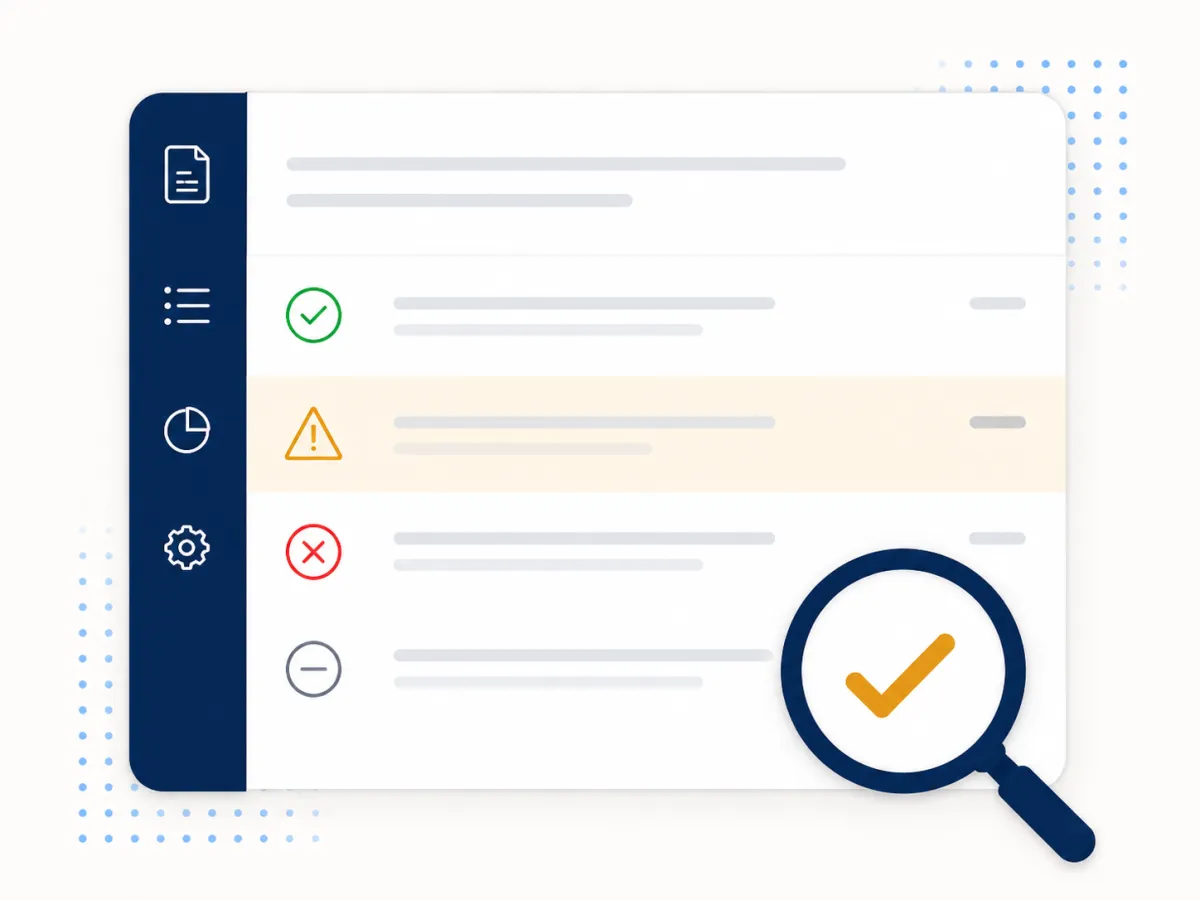
Every citation receives a clear verdict
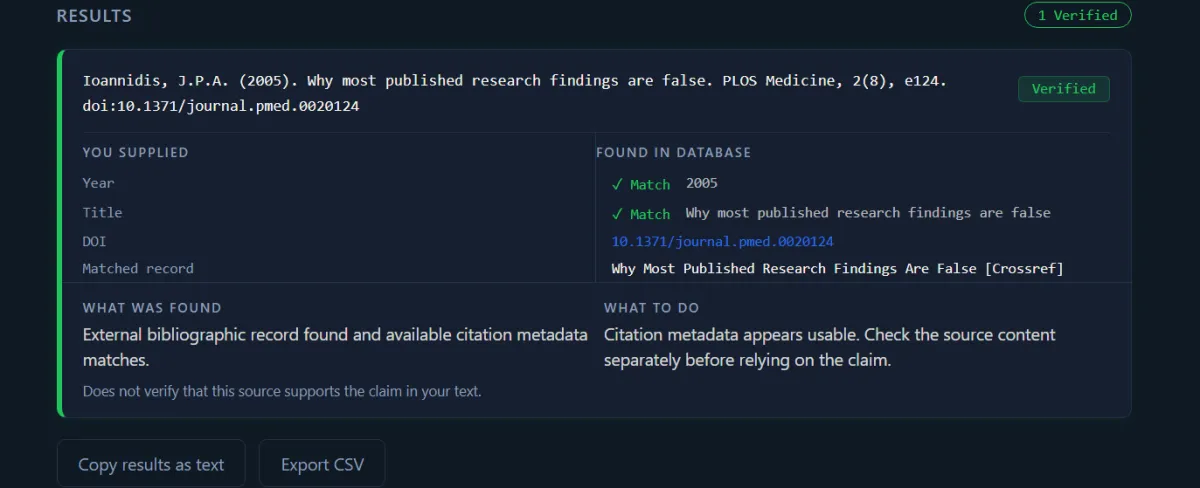
Verified
The citation matches trusted sources and metadata.
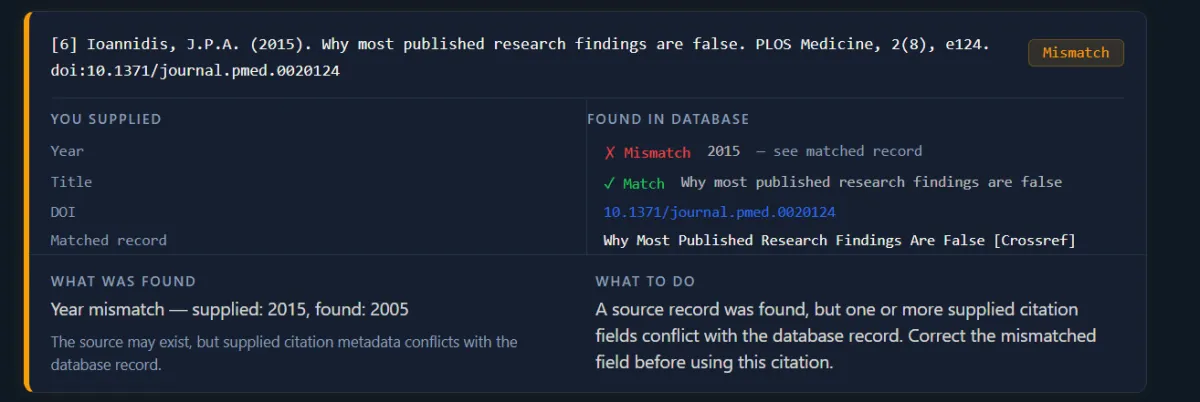
Mismatch
Details don’t match trusted sources or each other.
Not Found
We couldn’t locate a trusted source for this reference.
Incomplete
Key details are missing or insufficient to verify.
STILL NOT SURE?
Frequently Asked Questions
We understand lorem ipsum dolor sit amet, consectetur adipisicing elit.
What is a Citation Risk Report?
A Citation Risk Report checks the references in your document or reference list and shows which citations are verified, mismatched, incomplete, or not found.
It helps you catch reference problems before client delivery, thesis submission, publication, or review.
What does Citation Risk actually check?
We check whether citations appear to exist in public bibliographic databases and whether key metadata matches.
This includes details such as:
title
author
year
DOI
journal or publisher
source availability
The report highlights references that appear accurate, broken, incomplete, mismatched, or difficult to verify.
Does this prove that a source supports my claim?
No.
Citation Risk checks citation existence and metadata accuracy.
It does not yet prove that the cited source supports the argument or claim made in your text.
That is a later layer. For now, the goal is simple:
Are the references real, and do their details match?
Why do I need this if I already use a reference manager?
Reference managers help organize citations. They do not always catch fake, outdated, incomplete, or AI-generated references.
A citation can look properly formatted and still be wrong.
Citation Risk checks the reference itself, not just the formatting.
Can this catch fake AI-generated citations?
Yes, that is one of the main use cases.
AI tools can invent references that look convincing. Citation Risk checks whether those references can be matched against public bibliographic sources.
If no reliable match is found, the citation is flagged.
What do the verdicts mean?
Verified means the citation appears to exist and key metadata matches.
Mismatch means a source may exist, but important details do not match.
Not Found means no reliable matching source was found.
Incomplete means the citation does not contain enough information to verify confidently.
What is a metadata mismatch?
A metadata mismatch happens when part of the citation does not match the public record.
For example:
wrong year
wrong author
wrong title
DOI points to a different paper
journal details do not match
Small errors can create big credibility problems, especially in academic or client-facing work.
Who is this for?
Citation Risk is built for:
academic editors
thesis coaches
research support teams
postgraduate students
consultants
writers using AI-assisted research
anyone delivering citation-heavy work
The first focus is academic editors and thesis coaches.
What do the 2 free reports include?
Each free report checks one document or reference list with up to 25 citations.
The report shows which references are verified, mismatched, incomplete, or not found.

We provide legal services in every area of law practice since 1987

Real Estate
It is a long established fact that a reader will be distracted.

International Desk
It is a long established fact that a reader will be distracted.

Criminal Law
It is a long established fact that a reader will be distracted.
About Us
Citation Risk helps editors, thesis coaches, and research support teams catch fake, broken, mismatched, or incomplete references before a document is delivered or submitted. We focus on clear citation-risk reports: what matched, what failed, and what needs fixing.
Contact Us
Copyright © 2026. Lucidlock. All rights reserved.